.png?width=150&height=150&name=EORI%20LOGO%202025%20(6).png "EORI (UK) Limited")
In May 2025, the UK government announced it was pursuing a new SPS agreement with the EU. At its core, this means the UK is moving back towards aligning itself with EU rules across a huge range of areas, including animals, plants, food safety, labelling and pesticides. It is, by any measure, one of the most significant shifts in UK food and farming policy since Brexit.
The government's case for doing it is simple. Less paperwork, cheaper trade, fewer checks at the border and a tidier solution to the long-running headache of moving goods between Great Britain and Northern Ireland. On the surface, some of that is hard to argue with. The bureaucratic burden on smaller exporters since Brexit has been real.
But simplifying trade and dismantling biosecurity are not the same thing, and the government has been doing a fairly good job of presenting them as if they are. Strip away the language about growth and opportunity, and what you're really looking at is the removal of the checks and systems that have been quietly catching things that shouldn't be coming in and keeping diseases out of the country that would cost the farming sector billions if they arrived.
That's the conversation most people aren't having. And it's exactly the conversation we wanted to have with Tony Baldock, Corporate Director of Health and Wellbeing at Ashford Port Health.
The Comfortable Assumption That Isn't True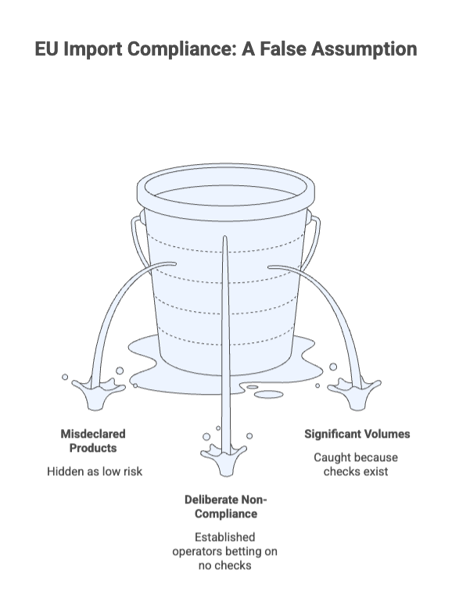
There's a foundational assumption baked into almost every government communication on this subject that EU imports are broadly safe, broadly compliant, and that the checks introduced post-Brexit have been an expensive exercise in finding very little. However, talk to the people who have been looking, and you get a very different picture.
Before we get to the politics, let's establish something important. The idea that EU imports arrive correctly declared and fully compliant is not what Ashford Port Health sees every single day. In fact, what Tony describes isn't a system that occasionally catches minor breaches; it's a system that regularly intercepts serious, deliberate non-compliance from established operators who are betting they won't be checked.
"There are a lot of products that are misdeclared as low risk and hidden in a trailer, when they are actually medium risk.. They're very common problems, and there are a lot of them."
These aren't small operators making paperwork errors. These are established businesses, caught in significant volumes, precisely because the checks exist. The question of what happens when those checks disappear answers itself.
Fraud Is More Common Than Anyone Is Admitting
So how much of what Ashford Port Health is a genuine mistake, and how much is deliberate fraud?
"At the moment, we see a fairly common amount, but I don't think we're looking enough for it, to be honest."
That's a significant admission. One of the country's most active border inspection operations believes they're only scratching the surface, and that the real scale is likely much higher than what they're currently catching.
Ashford Port Health has spent years building an AI-powered intelligence system that is only now reaching its full capability, able to spot the kind of patterns that deliberate fraudsters rely on, nobody noticing.
"If we carry on our trajectory with the product we've built, I think we can be so much more clinical, look for special customers, let's call them, and really call them out."
And it goes beyond food safety. The same operators gaming health declarations are almost certainly gaming customs too.
This costs the public purse in ways that never get added up into a single headline figure. And just as the tools to properly tackle it are coming online, the decision has been made to switch it all off.
"Head in the Sand"
Would DEFRA change it's mind if it saw what APH are seeing?
"I think there's just a head-in-the-sand approach. What we didn't do before, when we were in Europe, we didn't look at products coming from Europe, so we didn't see any problems. We've put a microscope on it, and we know that there are differences now. And we're just pretending they aren't. In my opinion, it's foolish."
The circular logic is worth unpacking. For years, no checks meant no findings. No findings became the evidence that checks weren't needed. Now that checks exist and problems are being found, the response is to remove them and return to the comfortable fiction that there's nothing to find.
The Channel: A Barrier We're About to Throw Away
Most people don't think about the English Channel as a biosecurity tool. But when you've spent as long as Tony has watching what tries to come through it, you start to see it very differently. It's not just water. It's one of the most effective natural barriers this country has, and it's doing a job that no amount of paperwork or land border checkpoints could replicate.
Tony puts it in terms that are hard to argue with.
"Metaphorically, the Channel Tunnel saved our bacon in the Second World War. It's kind of literally saved our bacon in real terms now we've left Europe, with ASF."
African Swine Fever is spreading across Europe right now. It doesn't stop at borders; it moves through them because most of those borders are patchwork land crossings with limited meaningful control. Tony drives through those borders regularly. He's seen them with his own eyes, and he's under no illusions about what they can and can't do.
"There's no way you can say a patchwork of land boundaries in Europe comes anywhere near the Channel as a barrier. That's why foot and mouth spreads around Europe and will continue. To pretend you've got good controls at land borders, it's impossible."
The Channel gives the UK something genuinely rare: a hard, defined, controllable entry point. You can staff it, monitor it, and inspect what comes through it. You cannot do that with a land border that stretches across multiple countries and crossings.
"It's nonsense to think you can control them all. So, it is really disingenuous to say it could be controlled. And yet here we are, apparently preparing to rely on exactly that."
A List That Should Alarm Every Farmer in Britain
We asked Tony to map out the disease picture in Europe right now. The list is long:
- African Swine Fever
- Classical Swine Fever
- Foot and Mouth Disease
- Lumpy Skin Disease
- Blue Tongue
- Goat Pox
Not one is present in the UK. All are present in Europe.
It seems like it's only a matter of time before one of these diseases makes it over. Not if but when. The only way you can get close to saying never is if we keep what we're doing, not get rid of it.
Years of Work, Thrown Away?
Here's what we keep coming back to. The government didn't stumble into the BTOM. They chose it. They built it, refined it, defended it in public, and told the industry it was the future of smart, modern border management. And now, apparently, it's gone.
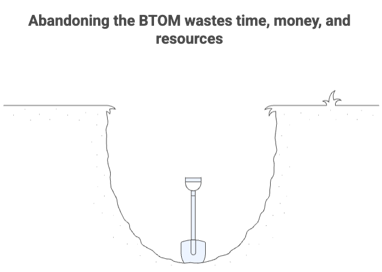 The whole thing is genuinely baffling, and frankly, it's hard not to share that feeling.
"I think the government is switching it all off. I don't think it's really mad saying it. We should be pushing another way, saying to Europe: this is the great way we're doing stuff. And we're going to throw it all in the bin. I don't get it." says Tony.
It raises an obvious question that nobody in government seems keen to answer. If the BTOM was a good system, why are they scrapping it? And if it wasn't, what does that say about the years spent building it and the experts who signed it off?
They spent a load of time building the BTOM, used their so-called experts, and they've put it in the bin unceremoniously. So, are they saying it was all rubbish? Or was it any good? You can't have it both ways.
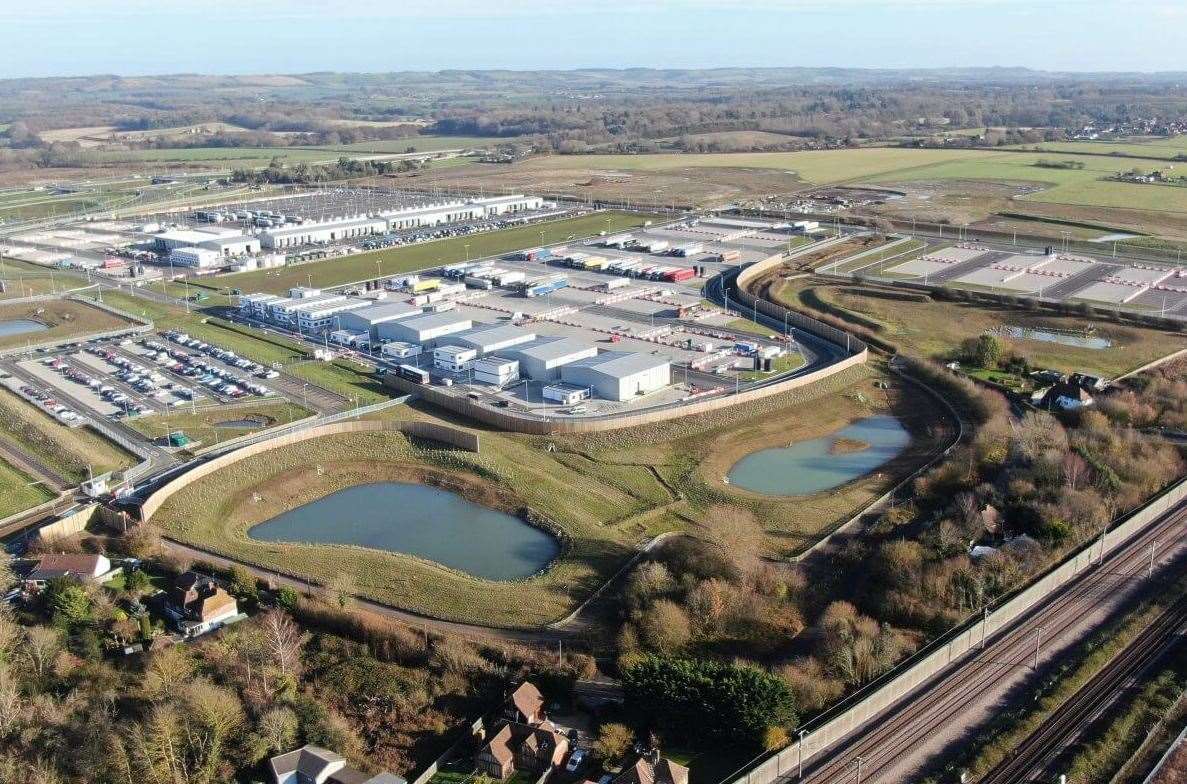
And then there's Sevington itself. A purpose-built facility, funded by the public, staffed and operational, that will, likely, just sit there.
"Money wasted. And obviously, the time and the infrastructure installed at Sevington will, I assume, just not be used at all."
It's that last line that lands hardest. Not fury, not outrage. Just a quiet, weary resignation from someone who watched it all get built and now has to watch it get abandoned.
The Windsor Framework
Nobody in government is saying this out loud, but plenty of people in the industry are saying it quietly. The Windsor Framework created a problem that was never cleanly resolved, and full SPS alignment is, conveniently, a way to make it disappear. If Great Britain and the EU are operating from the same rulebook, the distinction between goods heading to Northern Ireland and goods heading everywhere else simply stops mattering. Neat, tidy, and politically very useful.
"That is a train of thought a lot of people are following, that the Windsor Framework is a driver behind alignment. Because if we're all following the same rulebook, there are no issues between the North and the South."
And look, maybe that's a reasonable political trade-off. Maybe solving the Northern Ireland problem is worth something. But if that's the calculation being made, the public deserves to know it's being made, because it comes with a cost that isn't being mentioned in any of the briefings or press releases.
"With that comes a greater risk of contaminated products coming through the short straits."
That's the part of the equation that keeps getting left out. Solving one problem by quietly creating another isn't a policy success. It's just moving the risk somewhere less visible and hoping nobody notices.
Powerless at the Border
We wanted to understand, in practical terms, what actually changes on the ground. Not the policy language, not the ministerial reassurances, but what Tony and his team would actually be able to do once the new arrangements kick in. We asked him directly. His answer was about as stark as it gets. "Nothing. We'd be completely powerless." says Tony.
It's worth letting that sit for a moment. Not reduced capacity. Not a scaled-back operation. Nothing.
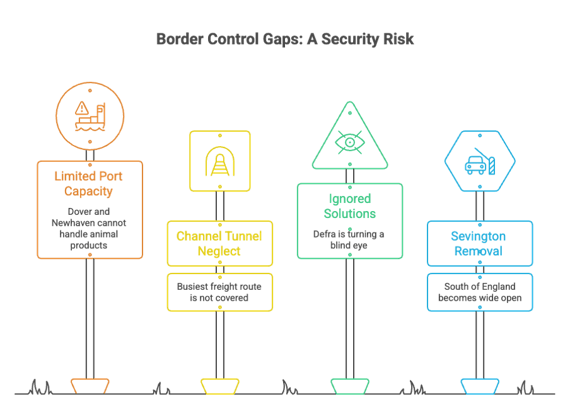
Dover cannot handle products of animal origin. Newhaven has no provision for them either. And then there's the Channel Tunnel, one of the busiest freight routes into the country, which has never been properly covered, and which Tony has raised with Defra more times than he can count, always to the same result.
"To pretend that we are covering the Channel Tunnel is a joke. We've mentioned that so many times to Defra. We've raised it many times and offered to help solve it. But DEFA just seem to be turning a blind eye."
There's a real frustration in that. Not just at the coverage gap, but at the fact that solutions have been offered and quietly ignored. Ashford Port Health aren't asking for more power or more resources for the sake of it. They've identified a problem, proposed a solution, and been met with silence.
Remove Sevington from the picture, south of England is essentially wide open.
"If we just get rid of all the controls in Sevington, there would be no border control posts in the south, really. They'll just come in. That's basically the truth."
British Farmers Left to Compete with One Hand Tied
It's easy for this debate to get lost in frameworks, acronyms and border infrastructure. But at the end of it all, there are farmers. People who are already having an extraordinarily difficult time, already watching costs rise and margins shrink, and who are now facing the prospect of being undercut by European products made to lower animal welfare standards at lower cost. Tony didn't dress it up.
"They will undercut British farmers. And that's just dreadful, really and it will be finished if that happens."
If There Has to Be a Middle Ground
The political reality may be that the full current regime is gone regardless. So, if that's where we're heading, what does a responsible version of it actually look like? To his credit, Tony didn't just defend the status quo for its own sake. He's thought about this, and he has a practical answer.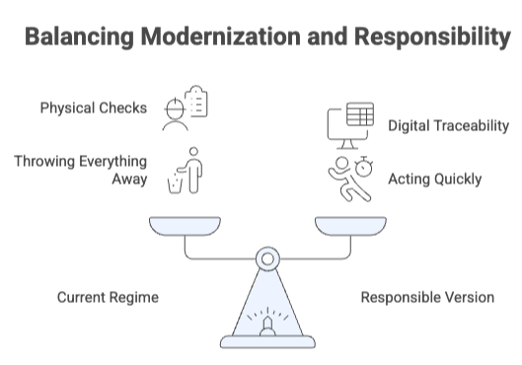
"If you have to say we don't do any physicals, that wouldn't be the most awful thing in the world. You could still have some kind of measure and control in the digital space and act quickly when needed. That's where they should be pushing, not just throwing everything away."
Digital traceability and intelligence-led targeting. These aren't ideas from a think tank paper. These are things Ashford Port Health have already been building. The frustration isn't that modernisation is impossible. It's that modernisation is being confused with simply walking away.
The Truth That Was Always There
We ended where the whole conversation had really been pointing all along. If EU imports were so consistently safe and compliant, why are problems being found now that someone is actually checking? Tony's answer is simple, and once you hear it, it's hard to unhear it.
.png?width=736&height=136&name=quote%20(1).png)
That one line dismantles years of comfortable assumptions. The absence of evidence was never evidence of absence. It was just the absence of looking. And now that someone has been looking and finding things, which costs money; the response is to stop looking again.
Tony has given his career to this. He's seen it all, built from the ground up, and he knows exactly what's being thrown away. His verdict is unambiguous.
"I think it is an absolute disaster and travesty what they're doing. It is a very silly thing what the government are up to at the moment."
His final message was aimed at the industry, and it felt like the most important thing he said.
"Don't take any notice of the professionals in the world of enforcement, just listen to trade. But if trade is saying don't do it, that will have far more weight than us. Hopefully that message will get across to DEFRA, and it's not too late to turn back."
It isn't too late. But it won't be long.
Our thanks to Ashford Port Health for speaking so openly and allowing us to quote them directly. What they do everyday matters, and it deserves to be heard.
Tony Baldock, Corporate Director of Health and Wellbeing
Responsible for the delivery of port health controls at the Ashford Border Control Post at Sevington Inland Border Facility, Tony leads the preparation and delivery of the BCP business plan in close collaboration with government departments and key stakeholders. He provides leadership and direction in the development and implementation of strategic objectives across a range of functions and services, ensuring that Ashford Port Health actively supports strategies that promote a caring borough and great environment through regulation, enforcement and engaged communities, with services delivered in accordance with legislation.
.png?width=140&height=140&name=quote%20(8).png)