CBAM

The Carbon Border Adjustment Mechanism


What is CBAM?

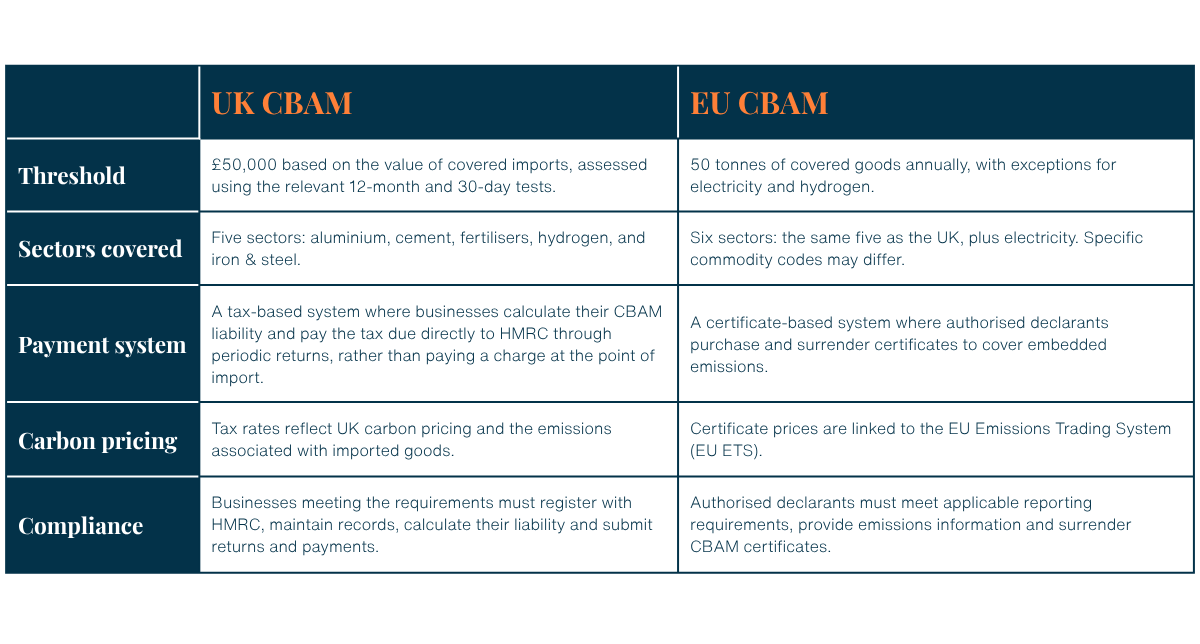
CBAM (Carbon Border Adjustment Mechanism) is designed to put a carbon price on certain goods imported into the UK and EU, helping to ensure imported products face comparable carbon costs to those produced domestically.

Both systems aim to reduce carbon leakage and encourage cleaner production. However, the UK and EU have introduced different rules, thresholds and requirements for businesses.


What is carbon leakage?

Carbon leakage happens when businesses move production to countries with less stringent climate policies or lower carbon costs, potentially shifting emissions elsewhere rather than reducing them.

CBAM aims to address this by applying a carbon cost to certain imported goods.

Cargo (5)

Same Idea. Different Obligations

blog post header (12)
The Key Difference?

Being compliant with one CBAM system doesn't automatically mean you're compliant with the other. Businesses importing into both markets need to understand the separate requirements and how they apply to their goods.

How does EU CBAM work?

EU CBAM applies to certain carbon-intensive goods imported into the European Union. Under the system, authorised CBAM declarants are required to account for the carbon emissions embedded in covered imports and surrender certificates corresponding to their obligations.

The amount payable depends on the emissions associated with the goods, with adjustments available in certain circumstances where a qualifying carbon price has already been paid during production.
Website Imagery (2)

What do EU importers need to consider?

Authorisation
Importers or their indirect customs representatives must establish whether authorised CBAM declarant status is required. The 50-tonne annual exemption applies to most covered goods, but not electricity or hydrogen.
 
Emissions information
Businesses need to understand the emissions associated with their imported goods and obtain relevant information from suppliers. Depending on the applicable rules, verified actual emissions data or permitted default values may be used.
 
CBAM certificates
Authorised declarants must manage their certificate obligations, with certificate prices linked to the EU Emissions Trading System.
Website Imagery (9)
 
Businesses importing goods covered by EU CBAM should review their commodity codes, check whether they need authorisation, and understand what emissions information they'll need from suppliers.
Keeping accurate import and emissions records also helps meet reporting requirements and manage certificate obligations.


Useful guidance:

EU CBAM definitive regime guidance ↗           EU CBAM official guidance ↗

How does UK CBAM work?

UK CBAM introduces a tax on certain carbon-intensive goods imported into the UK.

Unlike the EU's certificate-based approach, the UK system operates through a tax liability calculated on the emissions associated with covered imports. Businesses that meet the relevant requirements will need to register with HMRC, maintain appropriate records, calculate their liability and submit returns and payments.
Website Imagery (7)

Could your goods be in scope?

01

Iron & Steel

02

Aluminium

03

Cement

04

Fertilisers

05

Hydrogen

06

Electricity

Why your commodity code matters

Just because your goods fall within one of these sectors doesn't automatically mean they're covered by CBAM. The specific commodity codes included can differ between the UK and EU systems, making accurate classification essential.

Reviewing your commodity codes can help you identify which imports are affected and whether they count towards the relevant threshold.

Could CBAM affect your business?

CBAM isn't just something large manufacturers need to think about.

If your business imports certain carbon-intensive goods into the UK or EU, you may have additional customs, reporting or financial obligations.

Not sure whether CBAM applies to you? Start with these questions:

  • Are you importing goods covered by UK or EU CBAM?
  • Do your imports meet the relevant threshold?
  • Are you importing into the UK, EU or both?
  • Can your suppliers provide the emissions information you need?
  • Do you understand your registration and reporting responsibilities?

If you're unsure about any of these, it's worth reviewing your imports and understanding where your business stands.

 

Website Imagery (11)

What information will you need?

Understanding whether your goods are covered is only the first step.

Businesses may also need to collect and maintain information about their imports, suppliers and the emissions associated with producing their goods.

Commodity codes

Accurate classification to identify goods potentially covered by CBAM.

Supplier information

Details of where and how your imported goods are produced.

Emissions data

Information on the carbon emissions associated with producing covered goods.

Import records

Accurate records of import values, quantities and relevant declarations.


The sooner you understand what information you need, the easier it will be to identify gaps in your records or supplier data.

What is your supplier responsible for?

Suppliers and manufacturers can play an important part in providing the production and emissions information needed for CBAM.

Depending on the applicable requirements, businesses may need information about how goods are produced, their embedded emissions and whether those emissions have been independently verified.

However, providing the information isn't the same as being responsible for compliance.

The relevant importer or authorised CBAM declarant remains responsible for meeting their applicable CBAM obligations.

The key takeaway?

Make sure you understand what information your suppliers can provide and whether it meets the requirements of the relevant CBAM system.

Website Imagery (13)

Help is at hand!

With different requirements across the UK and EU, understanding how CBAM could affect your imports isn't always straightforward.
At EORI, we help businesses navigate customs requirements and keep up with the changes affecting international trade.
Whether you're reviewing your commodity classifications, identifying which goods may fall within scope or looking for guidance on your customs processes, our team is here to help.
Have a question about CBAM or how it could affect your imports?
Get in touch with our team at sales@eori.uk.


Trusted By

Fresh Ways
TFS
Theunisse
Schmitz logo
ECS
dominos pizza logo
Oakland-Logo
Royal Canin Logo
Sogedim logo
lactalis_logo
C&D_foods_logo
infusion-group-logo
MOY PARK
Pilgrims logo
GAZEBO COUSINE LOGO
tek_freight_logo
FAYREFIELD FOOD LOGO
ALCALINE GROUP CORE LOGO