
Claiming preference
Claiming preference usually requires proof of origin, such as a statement on origin, REX statement, or the use of the importer’s knowledge. If the requirements are met and correctly declared, importers can benefit from lower or zero duty rates on eligible goods.
Statement on Origin
A statement on origin is prescribed text added by the exporter to an invoice or other accompanying documents, declaring that the goods meet the relevant preferential origin rules. The exporter is responsible for ensuring the statement is accurate and correctly completed, and where required, providing a valid REX number for EU consignments over €6,000. They must also hold evidence to support the origin claim, including the origin of any materials used in the product. Where a supplier declaration is needed, it must be held at the time the statement is issued.
Record-keeping requirements apply to both sides. Both importer and exporter must keep copies of the statement on origin for 4 years, and the exporter should also keep supporting documents such as supplier declarations and invoices. HMRC may check claims through a verification process, so it's worth holding onto this evidence in case it's requested.
Long-Term Statement on Origin
A long-term statement on origin allows exporters to cover multiple shipments of a specific product with identical originating goods with a single originating declaration, rather than issuing a separate statement on origin for every consignment. This is especially useful where goods are supplied regularly to the same importer, reducing the administrative burden while still allowing preference to be claimed.
The statement must clearly state the period to which it applies. If the originating status of goods changes during that period, the exporter must stop using the long-term statement and issue a new one where appropriate.
Long-term statements on origin should be provided as a company-headed document and ideally stamped to show authenticity. Exporters will often send an email to confirm; however, an email alone is not adequate evidence.
Completing a Statement on Origin
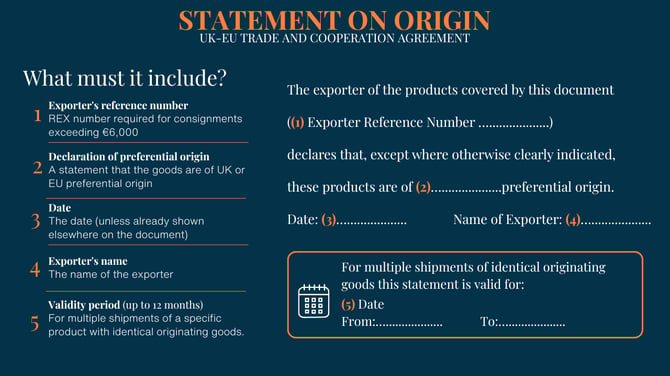
*For long-term declarations, use company-headed paper and, where possible, include a stamp and signature. If the statement is provided on an invoice, ensure the importer has confirmed proof of origin.
Importers Knowledge
Importer's knowledge is frequently associated with related-party transactions, where the importer has direct visibility of the manufacturing process and origin data. In these circumstances, customs authorities may take a closer interest in the valuation of the goods, as any undervaluation could affect both the customs value declared and the assessment of preferential origin. As with all preference claims, the supporting evidence must exist at the time the claim is made and cannot be obtained retrospectively to support an otherwise unsupported claim.
Do my goods qualify?
Preferential origin covers goods that are either wholly obtained or sufficiently processed. The rules governing preference vary by trade deal, so it's important to check each one individually, as what qualifies under one agreement may not under another. This can be misapplied where goods are non-originating but shipped from within the trading area. For example, Korean cosmetics shipped from France to the UK wouldn’t qualify for EU preference, as the goods originate from Korea, not the EU. Where there's doubt over the validity of preference, it's recommended to pay duty at the time of import and reclaim later.
Additional guidance on claiming preference: