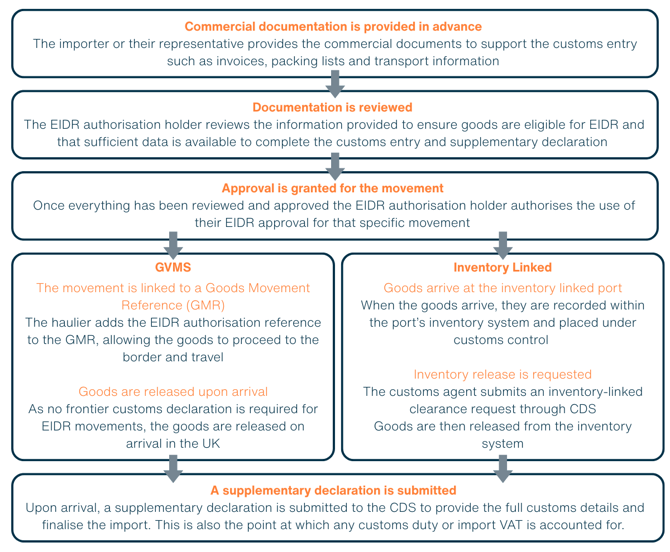
Entry In Declarant’s Records (EIDR) is a type of simplified customs declaration that allows traders to release goods immediately at the border by recording the declaration data in their own commercial records. Full customs data is then submitted via a supplementary declaration after the goods have arrived.
EIDR forms part of the UK’s Simplified Customs Declaration Process (SCDP), which is a set of facilitations designed to reduce the administrative burden associated with importing goods. SCDP allows eligible traders to move goods through customs more quickly by simplifying the customs process, such as with EIDR, where the submission of full customs data is deferred until after importation. It is intended to support trade efficiency while still ensuring HMRC receives the necessary data for revenue and compliance purposes.
Although HMRC authorisation is required to use EIDR, importers may be able to operate under a customs agent's authorisation where the agent holds the necessary approvals and agrees to act on their behalf. The use of an agent's authorisation is not automatic and must be approved on a case-by-case basis, with the agent satisfied that the importer, the goods being imported, and the proposed movements meet the requirements of the simplification. This means importers can benefit from the scheme without going through the approval process to obtain their own authorisation, enabling faster clearance and reduced administrative burden, particularly for smaller businesses.
Not all goods are suitable for declaration under EIDR, but it can be particularly effective for importers of general merchandise, retail products, industrial goods, manufacturing components, and other goods that are not subject to additional customs or regulatory controls. Typical movements include non-controlled goods or groupage shipments where goods can move efficiently without the need for additional certification or checks at the frontier.
EIDR is not suitable for controlled goods or goods subject to specific import restrictions or licensing requirements; this includes goods that require pre-notification, certification, or presentation at the border. For example, certain sanitary and phytosanitary (SPS) goods, including Products of Animal Origin (POAO), animal by-products, and plant and plant products, may require declarations and regulatory checks to be completed at the border before the goods can be released.
In addition, EIDR cannot be used for excise goods, goods requiring import licences, commodities subject to safeguards, or other commodities subject to increased checks. In these cases, a full frontier declaration is required, or in some circumstances a Simplified Frontier Declaration (SFD) may be used instead, depending on the nature of the goods and the approvals held.
Benefits of using EIDR
Faster clearance
EIDR allows eligible goods to be released without waiting for a full customs declaration to be submitted before arrival. This can significantly reduce the steps required at the border, and for businesses operating time-sensitive supply chains, this also reduces disruption to customer deliveries.
The physical release of goods is also separated from the calculation and collection of customs duty and import VAT. These charges are accounted for through the supplementary declaration process, allowing goods to continue moving through the supply chain without waiting for customs charges to be finalised at the point of import.
Reliability and business continuity
Because customs declarations are recorded directly in the trader's records at the time of import, EIDR reduces reliance on frontier declaration processing for the release of eligible goods. This can help businesses maintain the movement of goods during periods of increased demand, port congestion, or when customs declaration systems are experiencing delays or downtimes.
The ability to release goods using internal records provides greater flexibility and predictability, allowing businesses to plan logistics operations with more confidence and reducing the risk of supply chain interruptions.
Reduced administrative burden through aggregation
One of the key benefits of EIDR is the ability to consolidate multiple shipments into a single supplementary declaration. Rather than submitting a full customs declaration for every individual shipment, traders are able to aggregate eligible consignments imported during a reporting period and account for them together.
This can significantly reduce the administrative burden for businesses, particularly those that regularly import large volumes of goods.
How does EIDR work in practice?